
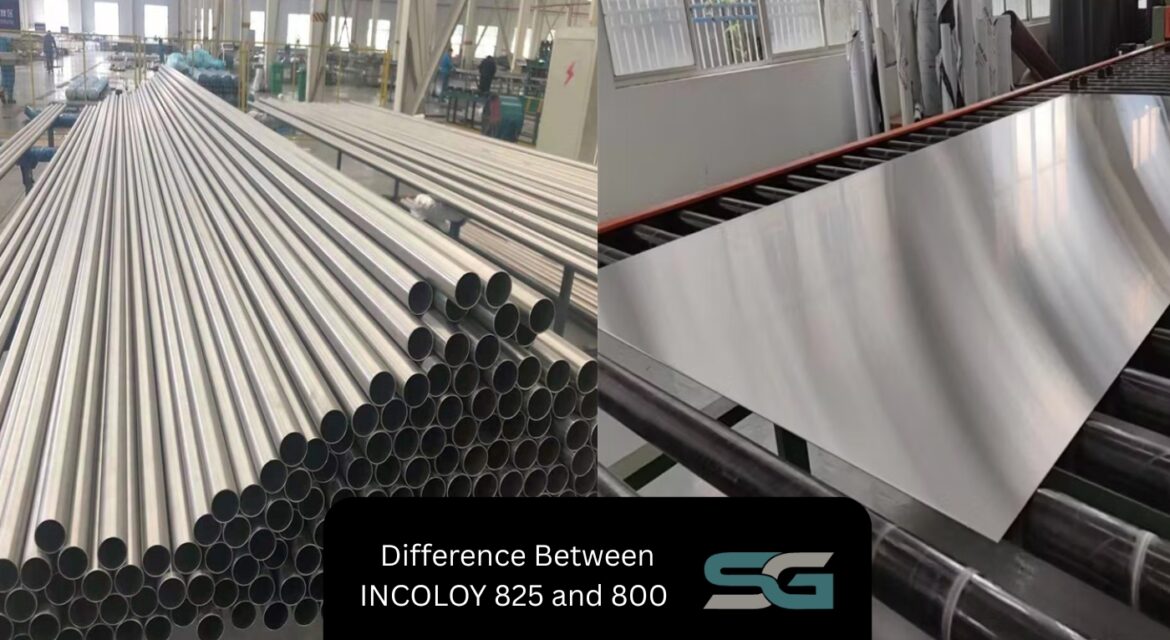
Nickel-based alloys play a crucial role in industries where extreme temperatures and corrosive environments are common. Among them, INCOLOY 800 and INCOLOY 825 are two widely used materials. Although they belong to the same nickel-iron-chromium alloy family, their composition, properties, and applications differ significantly.
Understanding the difference between INCOLOY 825 and 800 helps engineers, manufacturers, and buyers select the right material for long-term performance, cost-efficiency, and durability.
Introduction to INCOLOY Alloys
INCOLOY alloys are engineered to deliver excellent resistance to heat, corrosion, and oxidation. These alloys are commonly used in industries such as:
- Chemical processing
- Oil & gas
- Power generation
- Marine engineering
Both INCOLOY 800 and 825 are austenitic alloys, meaning they offer good strength, ductility, and resistance to corrosion. However, their design purpose is quite different.
1. Chemical Composition Difference
The primary difference between INCOLOY 800 and INCOLOY 825 lies in their chemical composition.
INCOLOY 800 Composition:
- Nickel (Ni): 30–35%
- Chromium (Cr): 19–23%
- Iron (Fe): Balance
- Small amounts of titanium and aluminum
INCOLOY 825 Composition:
- Nickel (Ni): 38–46%
- Chromium (Cr): 19.5–23.5%
- Molybdenum (Mo): 2.5–3.5%
- Copper (Cu): 1–2%
- Iron (Fe): Balance
The addition of molybdenum and copper in INCOLOY 825 significantly enhances corrosion resistance, especially in acidic environments.
2. Key Property Differences
a) Corrosion Resistance
- INCOLOY 825:
Offers superior resistance to reducing acids (like sulfuric and phosphoric acid), pitting, and crevice corrosion. - INCOLOY 800:
Provides good resistance to oxidation and general corrosion but is less effective in aggressive chemical environments.
If corrosion is your main concern, INCOLOY 825 is the better choice.
b) High-Temperature Performance
- INCOLOY 800:
Designed for high-temperature strength and stability, capable of operating up to ~800–870°C. - INCOLOY 825:
Suitable for moderate temperatures (typically below ~540°C).
For heat-intensive applications, INCOLOY 800 performs better.
c) Mechanical Properties
Both alloys have similar tensile strength and ductility in annealed condition. However:
- INCOLOY 800: Better creep resistance at high temperatures
- INCOLOY 825: Focuses more on corrosion resistance than strength
d) Resistance to Chlorides
- INCOLOY 825: Excellent resistance to chloride stress corrosion cracking
- INCOLOY 800: Moderate resistance
3. Applications Comparison
INCOLOY 800 Applications:
- Furnace components
- Heat exchangers
- Petrochemical processing equipment
- Power plant tubing
Ideal for high-temperature environments
INCOLOY 825 Applications:
- Chemical processing equipment
- Acid handling systems
- Marine and offshore applications
- Pollution control equipment
Best for corrosive and acidic environments
4. Cost Difference
- INCOLOY 800: More cost-effective
- INCOLOY 825: More expensive due to higher nickel, molybdenum, and copper content
If budget is a concern and corrosion is moderate, INCOLOY 800 is often preferred.
5. Quick Comparison Table
| Feature | INCOLOY 800 | INCOLOY 825 |
|---|---|---|
| Primary Purpose | High-temperature strength | Corrosion resistance |
| Nickel Content | Lower | Higher |
| Molybdenum & Copper | Not present | Present |
| Corrosion Resistance | Moderate | Excellent |
| Temperature Capability | High | Moderate |
| Cost | Lower | Higher |
6. How to Choose Between INCOLOY 825 and 800
Choosing the right alloy depends on your application:
- Choose INCOLOY 800 if:
- You need high-temperature strength
- The environment is not highly corrosive
- Budget is a concern
- Choose INCOLOY 825 if:
- You are dealing with acids or chlorides
- Corrosion resistance is critical
- Long-term durability is required
Conclusion
While both INCOLOY 800 and INCOLOY 825 belong to the same alloy family, they serve completely different purposes. INCOLOY 800 excels in high-temperature environments, whereas INCOLOY 825 is engineered for extreme corrosion resistance.
In simple terms:
- Heat resistance → INCOLOY 800
- Corrosion resistance → INCOLOY 825
Selecting the correct material ensures better performance, longer service life, and reduced maintenance costs.